
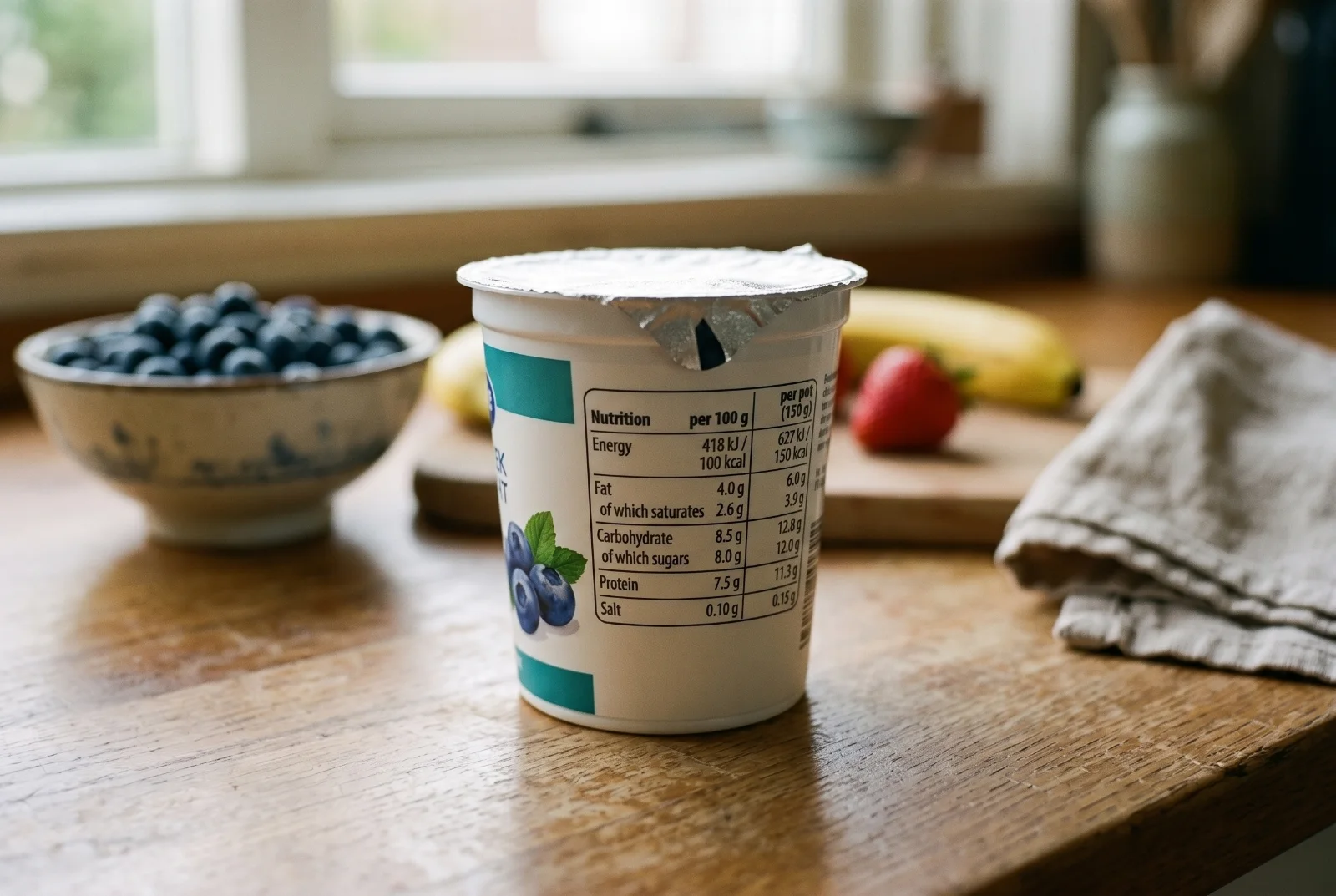
Calories and macros show up on every food label and in every diet conversation, but they're rarely explained properly. Once you understand what they are and what they do, a lot of confusing diet advice will make some more sense.
What a calorie actually is
A calorie isn't something in your food, like sugar or vitamins. It's a unit of energy, the same way a kilometer or a yard is a unit of distance.
What food labels call a "calorie" is technically a kilocalorie (kcal): the amount of energy needed to warm one liter of water by one degree Celsius. On European labels you'll also see kilojoules (kJ). That's the same energy in a different unit: 1 kcal is about 4.2 kJ.
So when a sandwich has 400 kcal, it simply means your body can get 400 kcal of energy out of it.
Where your energy goes
Your body uses energy all day long, even while you sleep. That daily use comes from three places:
- Keeping you alive (about 60–70%). Your heart, brain, lungs, body temperature and the constant repair of cells. This is your resting metabolism, and it runs whether you move or not. Thanks body!
- Digesting food (about 10%). Breaking down and processing what you eat costs energy too.
- Movement (the rest). Workouts, but also walking, taking the stairs, standing, cleaning, playing with the kids. This part varies the most between people, and everyday movement often adds up to more than a gym session.
Together, these make up your daily energy use. The amount of energy you'd need to eat to keep your weight stable is often called your maintenance level.
The energy balance
This is the core idea behind weight management:
- Eat more energy than you use, and your body stores the extra, mostly as body fat.
- Eat less than you use, and your body makes up the difference from its stores.
- Eat about the same, and your weight stays roughly stable.
That's why total kcal decide the direction your weight moves over time.
Two caveats. First, every number involved is an estimate: label values, calculators and fitness trackers all have a margin of error. Second, your body isn't a fixed machine. When you eat less for a while, it adapts slightly and uses a bit less energy. Neither of these breaks the rule; they just mean your actual real-world results over several weeks are a better guide than any calculation.
The three macros
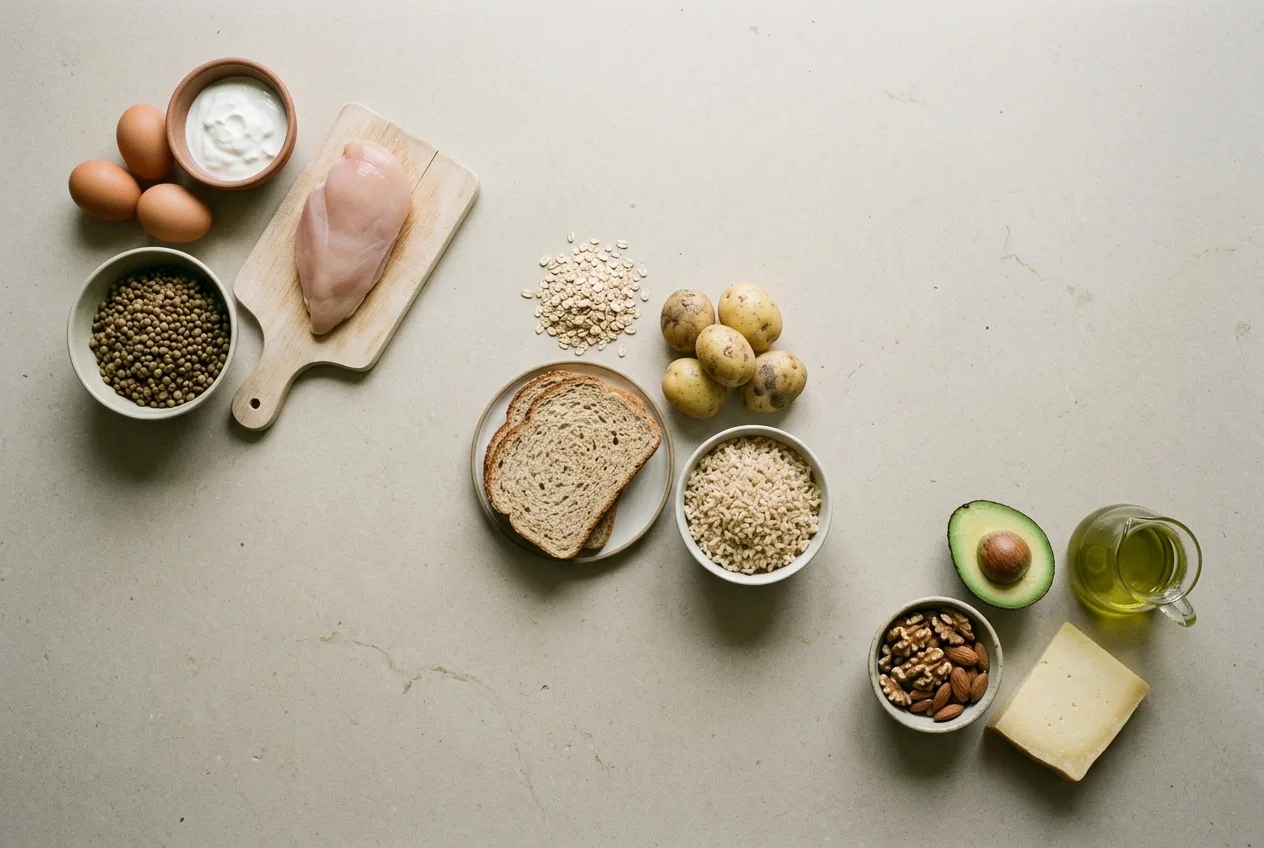
Macronutrients, or macros, are the three nutrients that give your food its energy: protein, carbohydrates and fat. Every food is some mix of these three. They provide energy, but each one also has its own job in your body.
Protein: the builder
4 kcal per gram.
Protein is made of amino acids, the building blocks for your muscles, organs, skin, hair, hormones and immune system. Your body is constantly breaking down and rebuilding these tissues, so it needs a steady supply.
When you're trying to lose weight, protein is especially useful:
- It keeps you full longer than carbs or fat.
- It helps you keep your muscle while you're eating less, so more of what you lose is fat.
- Your body spends more energy digesting protein than the other macros.
Good sources: meat, fish, eggs, dairy like yoghurt, skyr and cottage cheese, legumes, tofu.
Carbohydrates: the quick fuel
4 kcal per gram.
Carbs are sugars and starches, which your body breaks down into glucose. Glucose is the preferred fuel for your brain and for intense effort like sprinting or lifting. Your body stores some of it in your muscles and liver as glycogen, an energy reserve that holds on to water as it's stored.
Fibre is a carbohydrate too, but you mostly don't digest it. Instead it feeds the healthy bacteria in your gut, slows digestion and helps you feel full. Most adults are advised to get around 25–30 grams a day.
Not all carbs feel the same. A bowl of oats with fruit and a handful of sweets can have the same amount of carbs, but the oats keep you full for hours and the sweets don't.
Good sources: vegetables, fruit, whole grains, oats, potatoes, legumes.
Fat: the essential reserve
9 kcal per gram, more than double the other two.
Fat often gets a bad name, but you can't live without it. Your body needs it to make hormones, build cell walls, and absorb vitamins A, D, E and K. Some fats, like the omega-3s in oily fish, your body can't make itself, so they have to come from food.
Because fat is so energy-dense, small amounts add up quickly. A single tablespoon of olive oil is about 120 kcal. That's not a reason to avoid fat, just a reason to be aware of portions.
Good sources: olive oil, nuts, seeds, avocado, oily fish, eggs.
A note on alcohol
Alcohol isn't a macro, but it does contain energy: 7 kcal per gram, with no nutrients attached. Your body also prioritises getting rid of it, so burning other fuel is put on hold while it does.
Everything else: vitamins, minerals and water
Protein, carbs and fat aren't the only things in your food. You also need vitamins and minerals, often called micronutrients because your body needs them in tiny amounts: milligrams or even micrograms a day, compared to tens or hundreds of grams for the macros.
They each do essential work behind the scenes:
- Vitamins help your body run its daily processes. B vitamins help turn the food you eat into usable energy, vitamin C and D support your immune system, vitamin D helps you absorb calcium for strong bones, and vitamin A supports your eyes and skin.
- Minerals are part of your body's structure and wiring. Calcium builds bones and teeth, iron carries oxygen in your blood, and potassium, sodium and magnesium keep your nerves and muscles, including your heart, working properly.
- Water is involved in almost everything: transporting nutrients, regulating your temperature and removing waste.
Why they don't count for weight management
The answer is simple: vitamins, minerals and water contain no energy. They have 0 kcal, so they don't add to or take away from your energy balance. A vitamin pill won't make you gain weight, and it won't help you lose it either.
This also clears up a common misunderstanding: B vitamins are often marketed as giving you "energy", but they don't contain any. They help your body release energy from protein, carbs and fat. If you already get enough, taking more won't give you an extra boost.
There's one indirect effect worth knowing. Salt (sodium) makes your body hold on to more water for a while. After a salty meal, the scale can easily go up the next day without you having gained any fat. It's one more reason to look at your trend, not a single weigh-in.
Why they still matter when you eat less
Even though they don't affect your weight, micronutrients matter more when you're eating less, because there's simply less food to get them from. A smaller amount of food needs to work harder. That's another good reason to build your meals around vegetables, fruit, whole grains, legumes, dairy, fish and lean meat: they deliver plenty of vitamins and minerals for their calories, where sweets and snacks mostly deliver energy alone.
How to read a label
With those numbers, you can check any label yourself. Say a plain high-protein yoghurt lists, per 100 grams:
- Protein: 10 g → 10 × 4 = 40 kcal
- Carbohydrates: 4 g → 4 × 4 = 16 kcal
- Fat: 0 g → 0 × 9 = 0 kcal
Total: about 56 kcal. The label might say 55 or 58, because of rounding and fibre, but you now know exactly where that number comes from.
Calories versus macros: who does what
The simplest way to remember it:
Calories decide whether your weight goes up or down. Macros decide what that weight is made of and how easy the process feels.
Picture two people who both eat 1,800 kcal a day. One gets that from meals with plenty of protein, vegetables and whole grains. The other gets it mostly from biscuits and soft drinks. Over time, the scale may move in a similar way for both. But the first person will be less hungry, keep more muscle and have more energy, which makes it far more likely they'll keep going.
Common myths, cleared up
"Carbs make you fat." Eating more energy than you use makes you gain fat, whatever it comes from. Low-carb diets often show a quick drop on the scale in the first week, but that's mostly glycogen and the water stored with it, not fat.
"Fat makes you fat." Same answer. Fat is energy-dense, so it's easier to overeat, but it doesn't have a special fattening effect.
"Eating late at night makes you gain weight." Your body doesn't switch to storage mode after 8 pm. What matters is your total over the day and week. Late-night snacking is often a problem simply because it's extra food on top of everything else.
"A calorie is a calorie, so it doesn't matter what I eat." For energy, yes. For hunger, muscle, energy levels and health, no. What you eat strongly affects how many calories you end up eating.
"I'm up a kilo since yesterday, I gained fat." To store a kilo of body fat, you'd need to eat roughly 7,000 kcal more than you used. Day-to-day changes come from water, salt, carbs and food still in your digestive system. Watch the trend over weeks, not the number on one morning.
"The less I eat, the faster it works." Very large cuts lead to more hunger, more muscle loss, low energy and a much higher chance of giving up. A moderate, steady approach you can keep up beats a strict one you can't.
"I'll just burn it off at the gym." Exercise is great for your health, fitness and mood. But a 30-minute jog burns roughly what's in one large pastry. It's much easier to eat calories than to burn them, so exercise works best alongside sensible eating, not instead of it.
Putting it into practice
You don't need to become a nutrition expert. A few principles go a long way:
- Your total energy intake matters most for weight loss or gain.
- Include a source of protein in every meal to stay full and protect your muscle.
- Fill up on vegetables, fruit and fibre for volume with fewer calories, and plenty of vitamins and minerals.
- Don't fear carbs or fat, just be mindful of portions, especially of fats and oils.
- Judge your progress by the trend over weeks, not by a single day.
Consistency beats perfection. A reasonable routine you follow most days will always outperform a perfect plan you abandon after two weeks.
This article is general information. If you're pregnant, have a medical condition, or have a history of disordered eating, talk to your doctor or a dietitian before changing how you eat.